
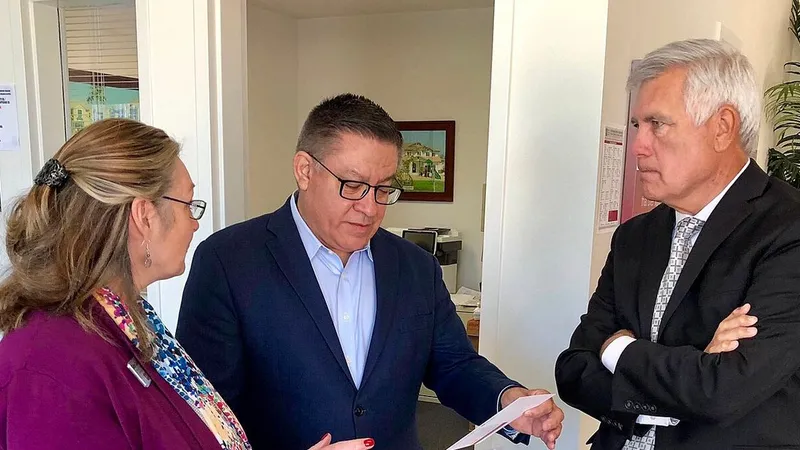
Congressman Salud Carbajal, a Democrat from Santa Barbara, is seeking his sixth term representing California’s 24th Congressional District in the U.S. House of Representatives. He faces a challenge from Bob Smith, a Carpinteria resident and retired U.S. Navy commander, in the upcoming election on November 3. Voters will decide between the incumbent, who emphasizes his track record of delivering results, and Smith, who calls for change and new leadership for the Central Coast.
Both candidates have outlined priorities focused on the cost of living and housing affordability. Carbajal’s top concern if re-elected is addressing the rising costs for essentials like gas, groceries, housing, and healthcare. He stated that "Families are hurting," indicating this is the immediate priority for Congress. He aims to restore the Affordable Care Act premium tax credit to help people retain healthcare coverage and wants to halt the war in Iran to reduce gas prices. Carbajal also proposes legislation to secure affordable childcare, provide down payment assistance for first-time homebuyers, and double the Pell Grant and financial aid for college students.
Smith, for his part, proposes solutions like deploying small modular reactors on federal property to lower energy costs. He also advocates for regional collaboration to foster a healthy housing ecosystem and suggests directing the Federal Reserve Board to reduce interest rates for first-time homebuyers. If elected, Smith's primary focus would be to bring federal funds to the community for projects such as a swimming pool and STEM labs for Carpinteria High School, improvements to roads and infrastructure, fire prevention and mitigation efforts, and building more housing in Lompoc.
Immigration is another significant issue for both candidates. Smith seeks to ensure protections and a pathway to citizenship for Deferred Action for Childhood Arrivals (DACA) recipients and individuals brought to the United States as children. He explained that these individuals had no agency in their arrival and are ethically due a legal pathway to citizenship. Carbajal emphasizes the need to reform U.S. Immigration and Customs Enforcement (ICE) and stop the separation of families, addressing what he describes as the distress ICE brings upon communities.
Carbajal has served in his current congressional seat since 2017. Before his time in Congress, he was a Santa Barbara County supervisor and is a U.S. Marine Corps Reserve veteran. He currently serves on the House Committee on Armed Services, the House Committee on Transportation and Infrastructure, and the House Committee on Agriculture. He points to his work on the bipartisan infrastructure law, which he states brought $1 billion and 13,000 jobs to infrastructure projects, as evidence of his effectiveness. He also highlights his sponsorship of the Childcare Availability and Affordability Act and his support for the designation of the Chumash Heritage Marine Sanctuary. Additionally, Carbajal seeks to stop what he refers to as the problematic restart of the Sable Offshore Corp. oil pipeline in Santa Barbara County, advocating instead for wind energy projects. He hopes his track record will earn his re-election in November.
Smith, a retired U.S. Navy commander and veteran, grew up in Philadelphia. He served as a defense systems engineer in the Navy, including deployments in Iraq, Afghanistan, and Somalia. After returning from deployment in 2010, Smith earned his master’s degree and worked with the Department of Defense, now known as the Department of War, on developing new technologies like radar, ships, or missiles to counter new threats. While listed as a Republican on the ballot, Smith announced in September that he changed his party preference to "no party preference." He explained this shift by drawing an analogy to a stadium falling apart, suggesting that people are arguing over team jerseys instead of solving problems. Smith expressed his intention to be a disruptor, emphasizing he does not want to be a career politician but aims to enter Congress for a few years to disrupt the system, solve problems, and then turn it over to the next problem-solver. He hopes voters agree it is time for new leadership.